
Following the explosion of the Cambridge Analytica
scandal, Facebook has been trying hard to cleanse itself from
misinformation and targeted content aimed at surreptitiously influencing
the democratic process in several countries.
But
the tech giant’s countermeasures don’t seem to be enough to stem the
tide of political manipulation in which both foreign and domestic actors
engage on the platform. Evidence disclosed by the Commons’ Select
Committee for Digital Culture Media and Sport (DCMS), suggests that a
website, whose financial backers are unknown, has targeted Facebook
users with paid political ads promoting a pro-Brexit, anti-Chequers
agenda. The ads also encouraged users in Leave-voting areas to cajole
their MPs into voting down the Chequers deal – collecting the users’
email addresses at the same time.
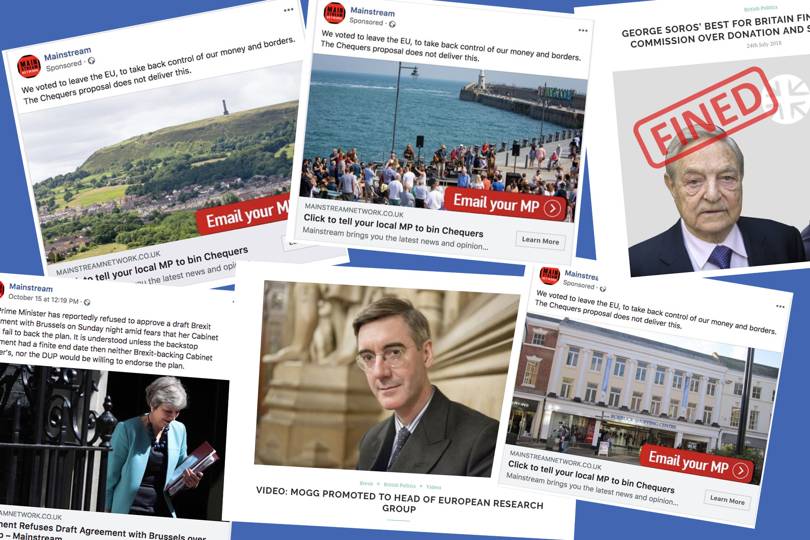
The evidence was gathered by 89up, a
London-based web content, social media, and PR consultancy. “We were
asked by the [DCMS] committee to check whether fake news is an ongoing
phenomenon,” company CEO Mike Harris says. The firm counts anti-Brexit
campaign Best for Britain among its clients, and has made no mystery of
its pro-Remain sympathies. While researching the topic, Harris stumbled
upon a Twitter post – specifically, an ad attacking Best for Britain –
which prompted him to search for more information about the website that
had published it.
"Here we have an example of a
clearly sophisticated organisation spending lots of money on a political
campaign, and we have absolutely no idea who is behind it," says Damian
Collins, the DCMS committee chair. "The only people who know who is
paying for these adverts is Facebook."
The suspicious website, called Mainstream Network,
was seemingly launched in December 2017. It publishes short news
pieces, almost all of them with a pro-Brexit slant, usually lifted or
slightly rehashed from other outlets and news agencies. The mysterious
website provides no information on who is behind it, editorially or
financially. Its footer, “@2017– Mainstream Network (UK). All Right
Reserved”, is an ostensible touch of officialdom, but according to
Companies House no active company is registered under that name in the
UK. (Also, that “@” standing in for “©” is pretty unsophisticated.)
Mainstream
Twitter and Facebook accounts have low subscriber counts – 471 on
Twitter and 12,000 on Facebook. Again, neither account gives any
information on who is controlling or funding them. The content they
share includes articles from the website, captioned pictures of
politicians, and videos about both Brexit and miscellanea (including
Mario Kart, the Oscars, Yuri Gagarin, CES 2018, and self-driving cars).
According
to the evidence from 89up, Mainstream has been investing heavily in
promoting its Facebook posts. “[Mainstream’s] advertising [is] estimated
at £257,000 in just over 10 months,” 89up’s report reads. Mainstream's
20 most popular posts on Facebook are said to have had engagement –
likes, comments and shares – from 140,000 people. But the whole Facebook
page is alleged to have reached 10-11 million people
“Furthermore,
the site has a sophisticated approach to content, with over 700 pages
indexed on Google,” the report reads. “We have reason to believe that
this is part of a sophisticated advertising campaign.”
Mainstream
has not responded to requests for comment at the time of publication.
“On November 7, all advertisers will have new requirements before they
can place political ads in the UK, including Mainstream Network," Rob
Leathern, director of product management at Facebook, said in a
statement. The company did not comment further on the Mainstream
advertisements.
إرسال تعليق